

By Propack Technologies / India's Leading Pharma Equipment Supplier & Manufacturing machines
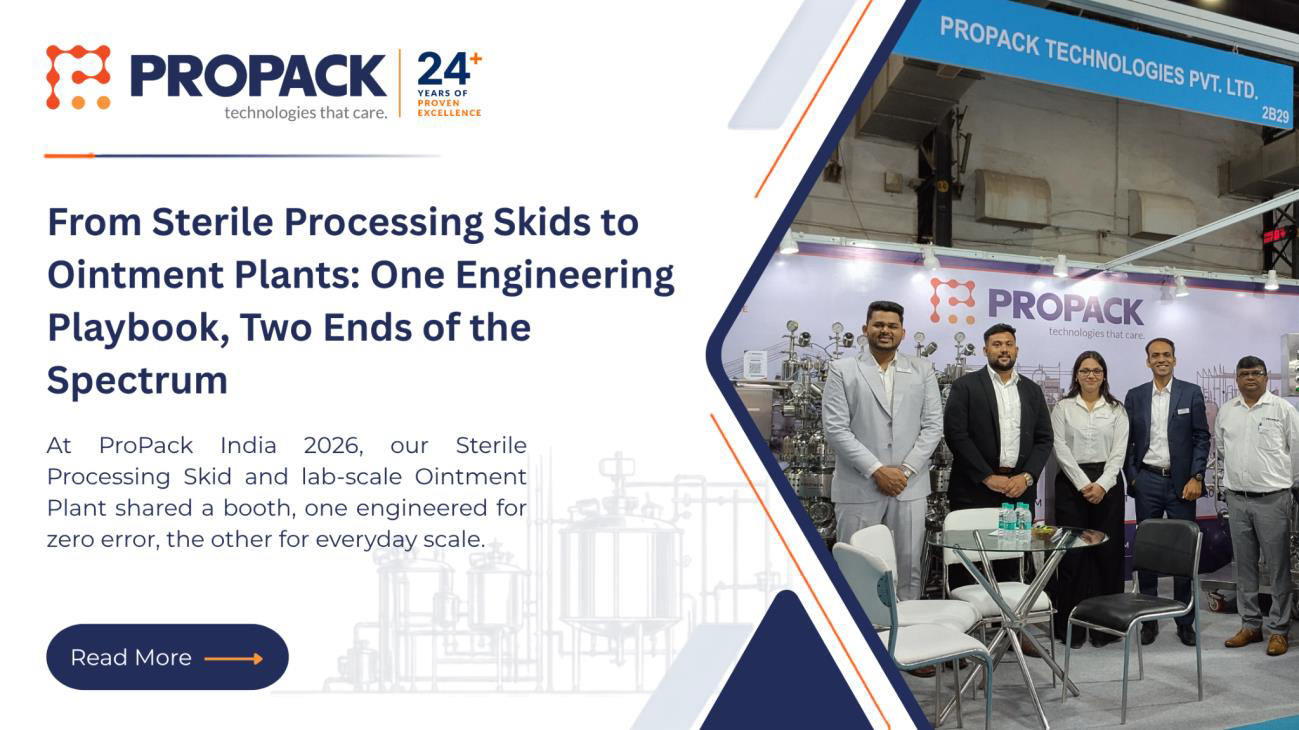
Inside ProPack Technologies' three days at ProPak India 2026, where a Sterile Processing Skid and a lab-scale Ointment Plant shared the same booth, one built for zero margin of error, the other for everyday production at scale.
Booth 2B29, Hall 2, Bombay Exhibition Centre, was where pharmaceutical, cosmetic, and food manufacturing professionals came to ask the same underlying question in a dozen different ways: can your machine actually handle what I'm trying to make?
ProPack Technologies spent ProPak India 2026 answering it, live, in front of the people who need the answer most. Here's what came out of those three days, and what it says about where processing equipment is headed.
Twenty-four years, one recurring question
Over the past 24 years, ProPack Technologies has built its experience through an integrated setup comprising a corporate office, an in-house R&D laboratory, and a manufacturing facility. This setup has resulted in more than 3,500 installations across 40 countries, with revenue split roughly 60:40 between domestic sales and exports.
With numbers like these, ProPack Technologies' sales and marketing leadership has been fielding different versions of the same question for some time. At the booth, visitors asked it repeatedly: What exactly do these machines make?
Sterile syringes and ketchup, and everything in between under the same roof
On the sterile side, ProPack Technologies engineers processing lines built around vials, ampoules, and prefilled syringes, applications where a single contamination risk can shut down a batch. On the non-sterile side, that same engineering approach goes into equipment for liquid pharmaceuticals, ointments and lotions, cosmetic formulations, and packaged food items.
Two of the units on the booth floor made that range tangible rather than theoretical. A 5 kg lab-scale Ointment Plant, sized at 1680 mm long, 1300 mm wide, and 1720 mm high, represented the non-sterile side at trial scale. Next to it stood a Sterile Processing Skid, with dimensions of 900 mm wide, 2100 mm high, and 1700 mm deep, built for the injectable side of the business.
Seeing both side by side made the sterile-to-non-sterile range easier to grasp than any spec sheet could.
It's an unusual range to hold in one company, and it's exactly why the conversations at the booth kept circling back to a second question: how far can these lines actually scale?
The 60,000-litre question
This is where the booth conversations got specific fast. On the top end, ProPack Technologies' equipment isn't off-the-shelf. Batch sizes are engineered per client specification and can reach 50,000 to 60,000 litres.
It's not a theoretical ceiling either: one of ProPack Technologies' own clients, a major pharmaceutical manufacturer, already runs its high-volume syrup production on a single 12,000-litre line, turning out entire batches in one continuous cycle rather than several smaller runs.
But scale on its own doesn't solve a client's formulation problem. That happens earlier, inside the company's R&D lab, where client-specific formulations are tested directly before a single unit goes into commercial production. It's the step that turns a generic processing vessel into equipment built around one client's actual product.
The shift nobody at the booth wanted to ignore
If there was one theme that kept resurfacing across all three days, it was automation.
The company's read on the industry is that automation has stopped being optional. What used to be almost entirely manual operation gave way to semi-automatic lines, and the next stage, full automation across the process, is already being adopted by many large manufacturers. For Tier-1 players in particular, running an entire process from one control point has gone from a nice-to-have to the baseline expectation.
Smaller operators aren't there yet, and for good reason. Budget constraints and the availability of skilled labour still shape which equipment makes sense for them today. But the direction of travel is clear enough that manual lines are increasingly being treated as a transitional technology rather than a long-term choice.
Three days, in real time
The booth itself told this story in motion. Day 1 opened with a steady flow of pharmaceutical and processing industry professionals, engineers, and decision-makers stopping to look closely at the equipment on display, ask about specifications, and start the kind of detailed conversation that doesn't happen over email.
By Day 2, those conversations had deepened into real discussions around process requirements and manufacturing technology, with the booth staying busy through the final hours.
By the time Day 3 wrapped, the takeaway was less about any single machine on the floor and more about a pattern: manufacturers across pharmaceutical, cosmetic, and food processing are all converging on the same set of demands (precision, scalability, and a path towards full automation) just arriving at that point from different starting lines.
Where this goes next
Three days at ProPak India 2026 confirmed what ProPack Technologies has proven over 24 years of excellence: the gap between a standard processing vessel and one engineered around a specific product, batch size, and automation level is where the real conversation happens.
That's the conversation the R&D lab exists for, long after the exhibition hall lights go down.
To Find More Information
If your process requirements didn't get fully answered on the show floor, that conversation doesn't have to wait for the next exhibition. Connect with Propack Technologies to discuss your requirements.


